
Filtration, disinfection and measured routine care
Clear water depends on a complete treatment chain—not one product
Hot-tub water care has separate jobs: remove particles, reduce microorganisms, maintain the water balance required by the chosen treatment, clean the system and replace water when reliable control is lost. A sand filter, UV-C unit or multi-function tablet solves only part of that chain.
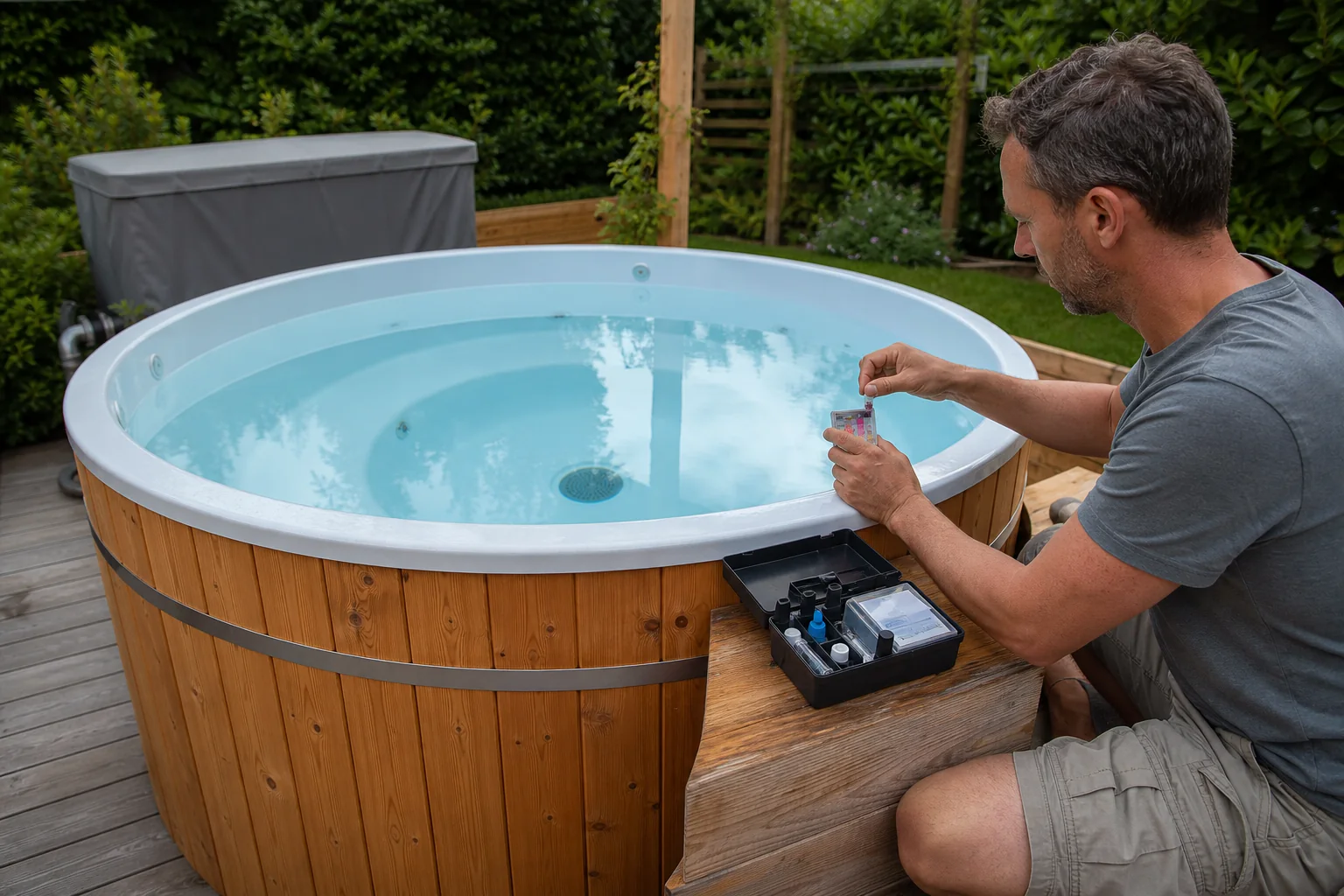
The water-care routine in five steps
- Remove coarse debris. Keep leaves, grit and visible contamination out of the circulation system and clean the accessible surfaces.
- Filter the circulating water. Run a correctly sized, maintained filter long enough for the actual water volume and bather load.
- Use UV-C where fitted. Treat filtered flowing water in the UV chamber, keeping the lamp, sleeve and flow conditions within the equipment instructions.
- Test and disinfect. Measure the relevant values and apply only a compatible product at the dose stated on its current label and system instructions.
- Clean or replace water when control is lost. Do not try to rescue persistently cloudy, foamy, poorly balanced or difficult-to-control water indefinitely.
Fresh-water use or longer water retention?
Fill, use and drain
A simple private routine can use fresh water for a short bathing period and drain the tub afterwards where this is practical and lawful. The tub, heater, drains and accessible pipework still need cleaning, and water must never be heated without the specified level and circulation.
Keep water for repeated use
Water retained for days or weeks normally needs circulation, filtration, testing and a controlled disinfection plan. A cover reduces debris but does not replace treatment. The higher the bather load and temperature, the more closely the system must be monitored.
The right choice depends on the tub, water source, season, frequency of use and installed equipment. Commercial and holiday-let operation may be subject to different duties and professional monitoring requirements; this page is general guidance, not a substitute for the applicable rules.
Test the water before correcting it
Cloudiness, smell or colour can indicate a problem, but they do not identify the exact cause. Use a test method intended for the treatment system and measure at a representative point. Follow the kit instructions for sample timing, storage and interpretation.
pH
pH affects bathing comfort, corrosion, scale and how many disinfectants work. Correct it within the range required by the current product and equipment instructions before repeatedly adding more disinfectant.
Disinfectant
Measure the relevant active residual where the chosen method requires it. A high reading is not automatically safer and can damage materials or irritate bathers.
Water balance
Source-water hardness, alkalinity and dissolved solids influence pH stability, scale and corrosion. Test only parameters the chosen method can interpret reliably.
Chlorine, bromine, active oxygen or salt electrolysis?
| Method | What it does | Planning points |
|---|---|---|
| Chlorine-based treatment | Provides a measurable disinfectant residual when used correctly. | Active ingredient, pH, water volume, dosing method, contact time and material compatibility must follow the label and equipment instructions. |
| Bromine-based treatment | Can provide a residual suited to warm water in compatible systems. | Use only where the tub and equipment allow it. Do not switch casually between chemical programmes. |
| Active oxygen systems | Alternative oxidation/disinfection programmes used with their own activators and testing routines. | Do not assume the term means chemical-free. Use the complete approved programme and its test method. |
| Salt electrolysis | Generates a disinfecting agent from dissolved salt in a compatible circulation system. | Salt concentration, cell sizing, metal exposure, heater, seals and warranty all require written compatibility. Salt water is not simply “fresh water with less maintenance”. |
| UV-C | Treats passing water inside the chamber and can reduce susceptible microorganisms. | It leaves no lasting residual in the tub and therefore usually supplements filtration and the wider treatment plan. |
Two stages, two different jobs
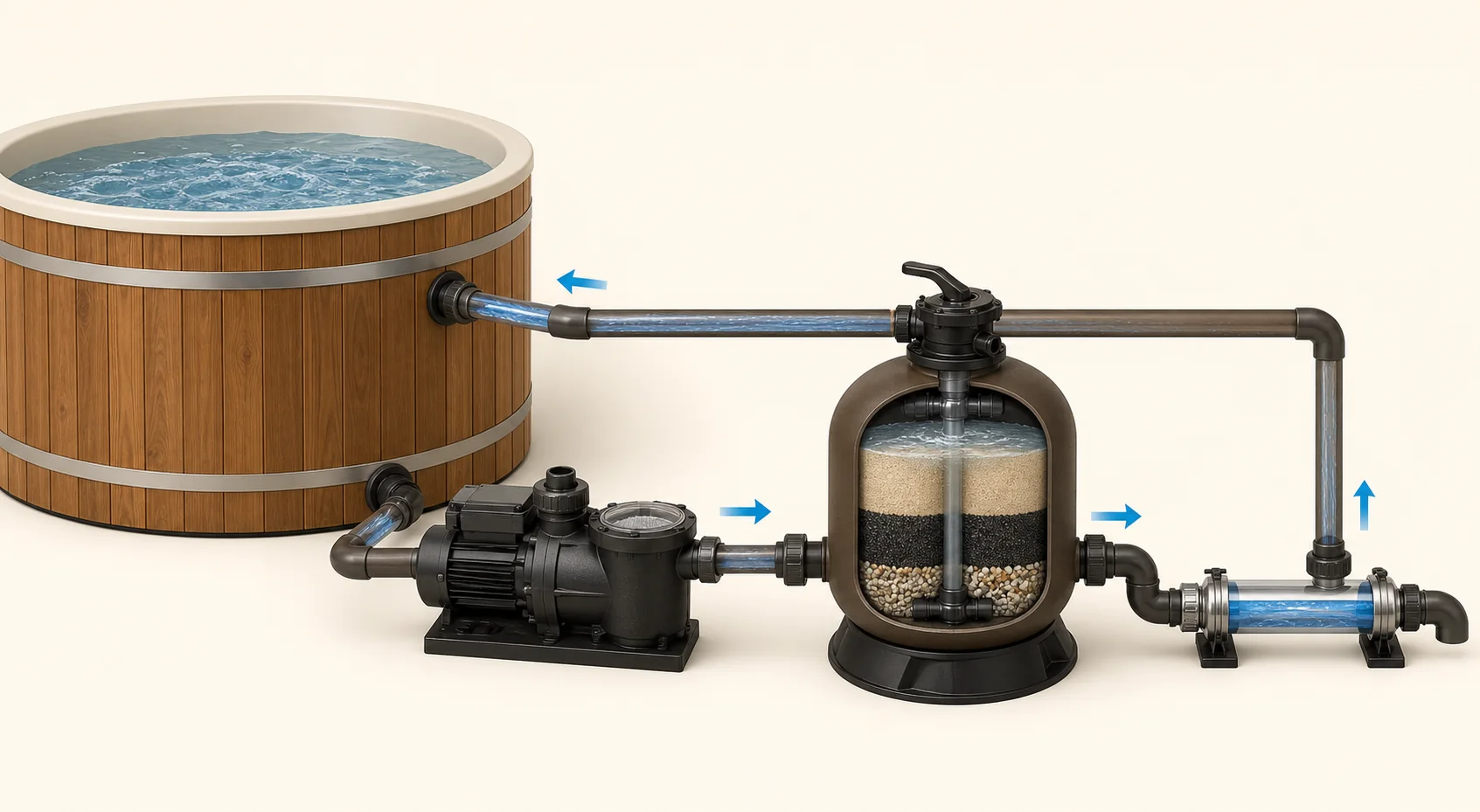
Sand filtration and UV-C work in sequence
A sand filter captures suspended particles and organic debris. It does not reliably disinfect the water. A UV-C unit is normally installed downstream of effective filtration so clearer water passes through the irradiation chamber.
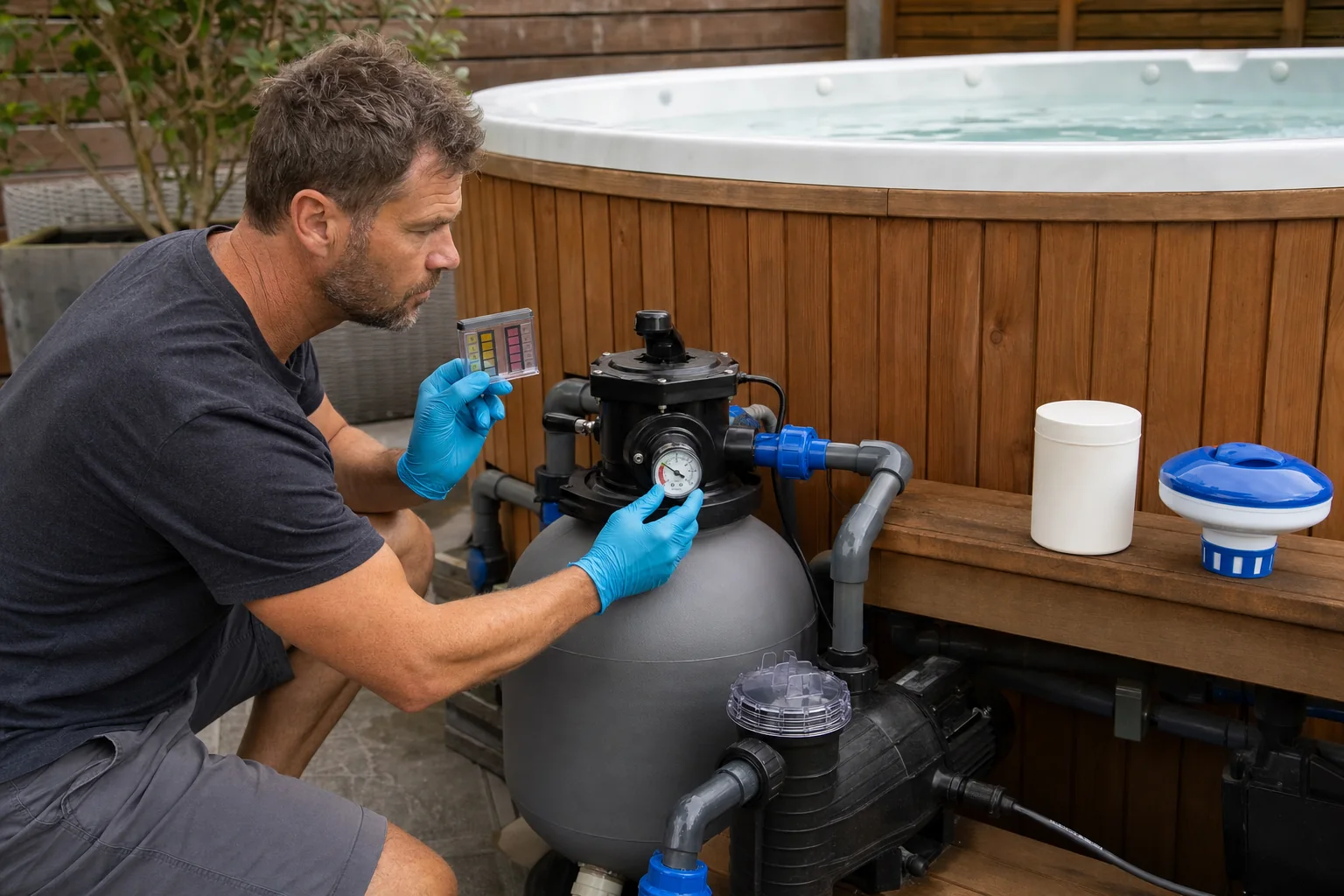
The circulation pump, filter media, multiport valve, pressure reading, hoses and UV-C flow range must match. Dirty filter media, a scaled quartz sleeve, an aged lamp or excessive flow can reduce performance.
- Backwash or clean only as the filter manual requires.
- Replace filter media and UV lamps at the specified intervals.
- Never look directly at an operating UV-C source.
- Isolate electricity and pressure before servicing.
- Protect pumps, vessels and pipework against freezing.
Multi-function products
How to assess 5-in-1 tablets and algaecides
A multi-function tablet can combine a disinfectant with ingredients intended to support algae control, flocculation or water balance. “5-in-1” is a marketing category, not a universal recipe. Read the exact active ingredients, permitted water volume, dispenser method and warnings.
An algaecide is a preventive or corrective product for algae in compatible water systems. It does not remove leaves, replace filtration or correct an unsuitable pH. Repeated algae growth usually requires investigation of circulation, disinfectant control, light exposure, surfaces and cleaning—not just more product.
Troubleshooting by symptom
Cloudy water
Check filtration run time, filter condition, bather load, pH and the chosen disinfectant reading. Remove debris and clean the system. If control cannot be restored reliably, drain, clean and refill.
Green water or slippery surfaces
Stop bathing. Check circulation, filtration, pH and disinfectant control, clean surfaces and follow the approved treatment instructions. Persistent algae indicates a system or maintenance problem.
Foam
Cosmetics, detergents, oils and accumulated dissolved material are common causes. Reduce contamination, clean the filter and consider a water change rather than masking the symptom.
Strong “chlorine” smell
Odour can indicate contaminated water and combined chlorine, not simply too much free chlorine. Test the water and follow the product programme rather than adding chemicals by smell.
Scale
Check pH, source-water hardness and heating surfaces. Use only a treatment approved for the liner, heater and circulation equipment.
Rust or metal staining
Review pH, chloride/salt exposure, incompatible chemicals, damaged protective surfaces and dissimilar-metal contact. Correct the cause before cosmetic cleaning.
A practical control plan
| When | Check | Action |
|---|---|---|
| Before use | Clarity, odour, visible debris, circulation and required test values. | Do not use the tub if the water cannot be verified as suitable under the chosen programme. |
| After heavier use | Bather contamination, filter pressure/flow and treatment demand. | Clean, test and run the system for the actual load; follow the approved product instructions. |
| At the filter interval | Media condition, pressure, valve operation, pump basket and leaks. | Backwash, clean or replace components only as the equipment manuals specify. |
| At the UV-C interval | Lamp age, quartz sleeve condition, seals and safe flow. | Isolate the equipment and service it according to the UV-C manufacturer. |
| When water remains unstable | Repeated pH drift, cloudiness, foam, odour or treatment demand. | Stop bathing, investigate the system and replace the water when reliable control cannot be regained. |
Frequently asked questions
Does a sand filter kill bacteria?
No. It is a mechanical filter for suspended material. Hygienic control requires the wider treatment plan.
Does UV-C mean no disinfectant is needed?
Not automatically. UV-C treats only water passing through the chamber and leaves no residual protection in the tub. Follow the complete approved system.
Can I put a tablet directly into the tub?
Only if the current product label and TimberIN configuration explicitly allow that method. Concentrated chemicals can damage liners, timber and equipment; a compatible dispenser may be required.
How often should the water be changed?
There is no safe universal calendar. Testing, bather load, temperature, filtration and the ability to maintain stable control determine the interval.
Can salt water be used in every TimberIN tub?
No. Obtain written compatibility for the liner, heater, pumps, seals, jets and metal parts before using salt electrolysis or elevated salt concentrations.
Is clear water automatically safe?
No. Water can look clear while treatment is inadequate. Use the required testing and operating checks.
Specify the treatment system with the tub
Confirm filtration, UV-C and chemical compatibility
Ask which connections and accessories are available for the selected model, then follow the current manuals and product labels for the final installed system.